INDUSTRIES / FOOD PROCESSING
Define cleanability before fabrication.
For processing and handling areas, material choice is only the beginning. Specify product contact, drainage, cleaning access and the surface conditions your process requires.
CONTEXT / REQUIREMENTS
Fabrication in its working environment.
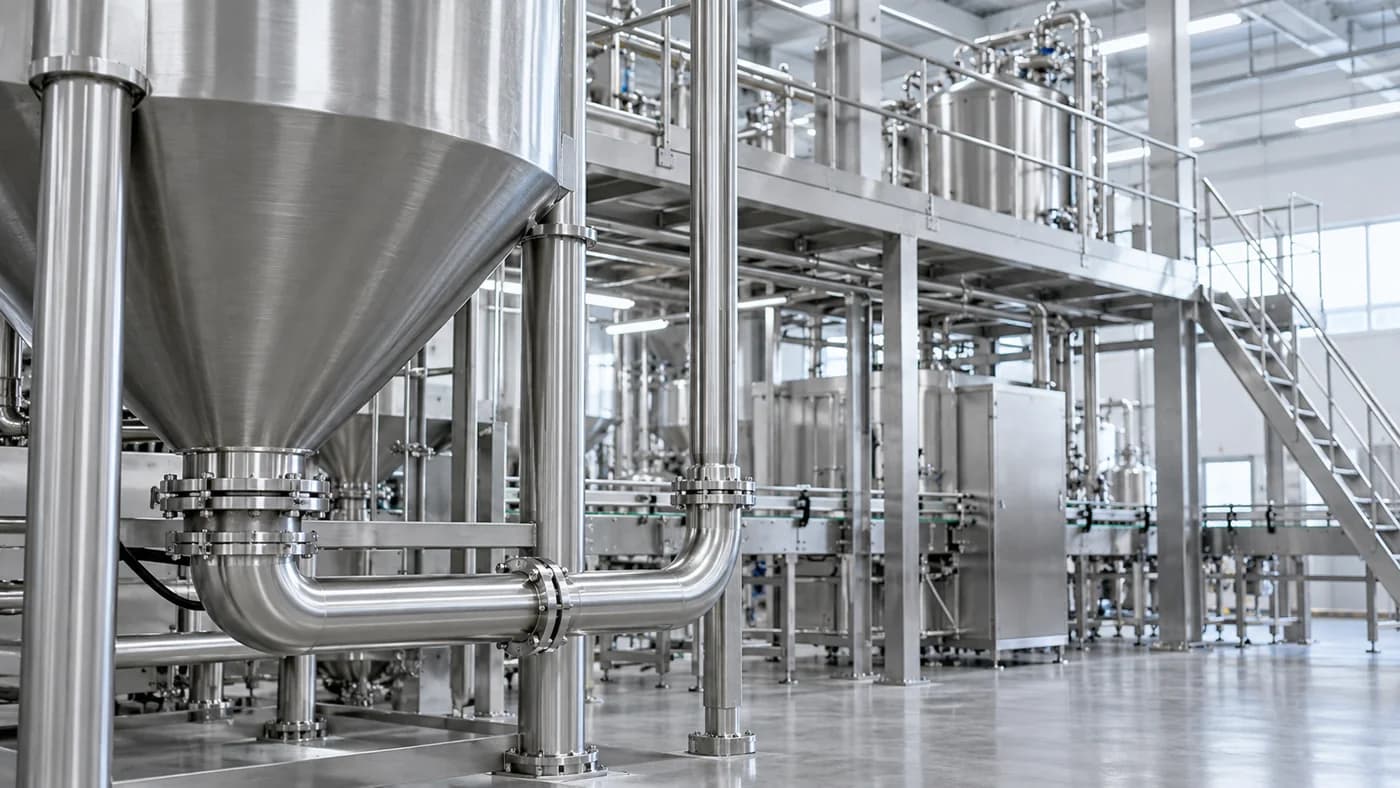
Food-processing fabrication can include product guides, hoppers, worktables and equipment covers. Components in direct product contact may have different requirements from dry-area supports or external enclosures.
Identify the process environment and the applicable hygienic specification. A smooth stainless surface does not by itself establish sanitary suitability or regulatory approval. Joint details, access, drainage and documented acceptance all need consideration.
APPLICATIONS / COMPONENTS
Potential components for your sector.
Examples for scoping a project. Final suitability depends on the design and operating conditions.
Product chutes
Transitions with flow, contact surfaces and cleaning access defined.
Hoppers
Feed assemblies with contents, discharge and drainage requirements.
Work surfaces
Tables and preparation-area components with edge and support details.
Equipment covers
Removable covers that preserve maintenance and inspection access.
Splash and separation panels
Formed panels with sealed interfaces or drainage as required by the design.
Stainless supports
Equipment-related frames with cleaning exposure and connection details identified.
SPECIFICATION / REVIEW
Plan the procurement, not just the part.
Describe the cleaning regime
Provide cleaning agents, operating temperatures, washdown practices and product-contact zones.
Define hygienic acceptance
Specify surface requirements, weld treatment, crevice control and the method used to review cleanability.
Coordinate access and release
Identify production separation, cleaning after installation and the party responsible for authorizing use.
CONNECTED PROCESSES
Complete the fabrication scope.
QUESTIONS / ANSWERS
Before you specify.
Does stainless steel automatically make a component food-safe?
No. Grade, surface condition, geometry, cleaning and the intended use all matter. Provide the applicable requirements for the actual process.
When should 316 be considered instead of 304?
The chemical environment, chlorides and temperature influence selection. 316 can improve resistance in some conditions, but neither grade is universally suitable.
How should weld finishes be described?
Identify product-contact faces, required treatment and any measurable surface criteria. A visual finish description alone may not establish acceptance.
What is needed for a hopper quote?
State the product, flow behaviour, dimensions, capacity requirements, supports, connections and cleaning method. Identify pressure or other regulated duty explicitly.
DEFINE YOUR PROJECT
Bring your food processing requirements.
Include the application, drawings, material preferences, quantities, delivery location and schedule. Identify inspection and installation requirements for review.