BUYER GUIDE / DRAWING TO QUOTATION
Prepare a fabrication RFQ.
Make the scope clear.
A useful inquiry distinguishes what is fixed, what is preferred and what needs review. Use this checklist to give contractors, engineers and procurement teams a common basis for discussion.
Required to start. Details to resolve.
Bring the essentials
Contact details, company, project description, service category, approximate quantity, material family, city and province. The form identifies each required field and allows you to review your answers before submission.
Flag what is undecided
Exact grades, finishes, budget and drawings can be clarified as the scope develops. Use “Other” when the listed material families do not fit, and explain the requirement. Do not guess an engineering specification to complete a field.
01
Start with the job the part must do
Describe the application, end-use location and whether the request is for a new part, a modification or a replacement. Identify the mating equipment and any load, exposure, cleaning or access requirements already established by your design team. Include a contact who can resolve technical questions. You do not need to select every fabrication process before starting an inquiry.
02
Keep drawing identity and units consistent
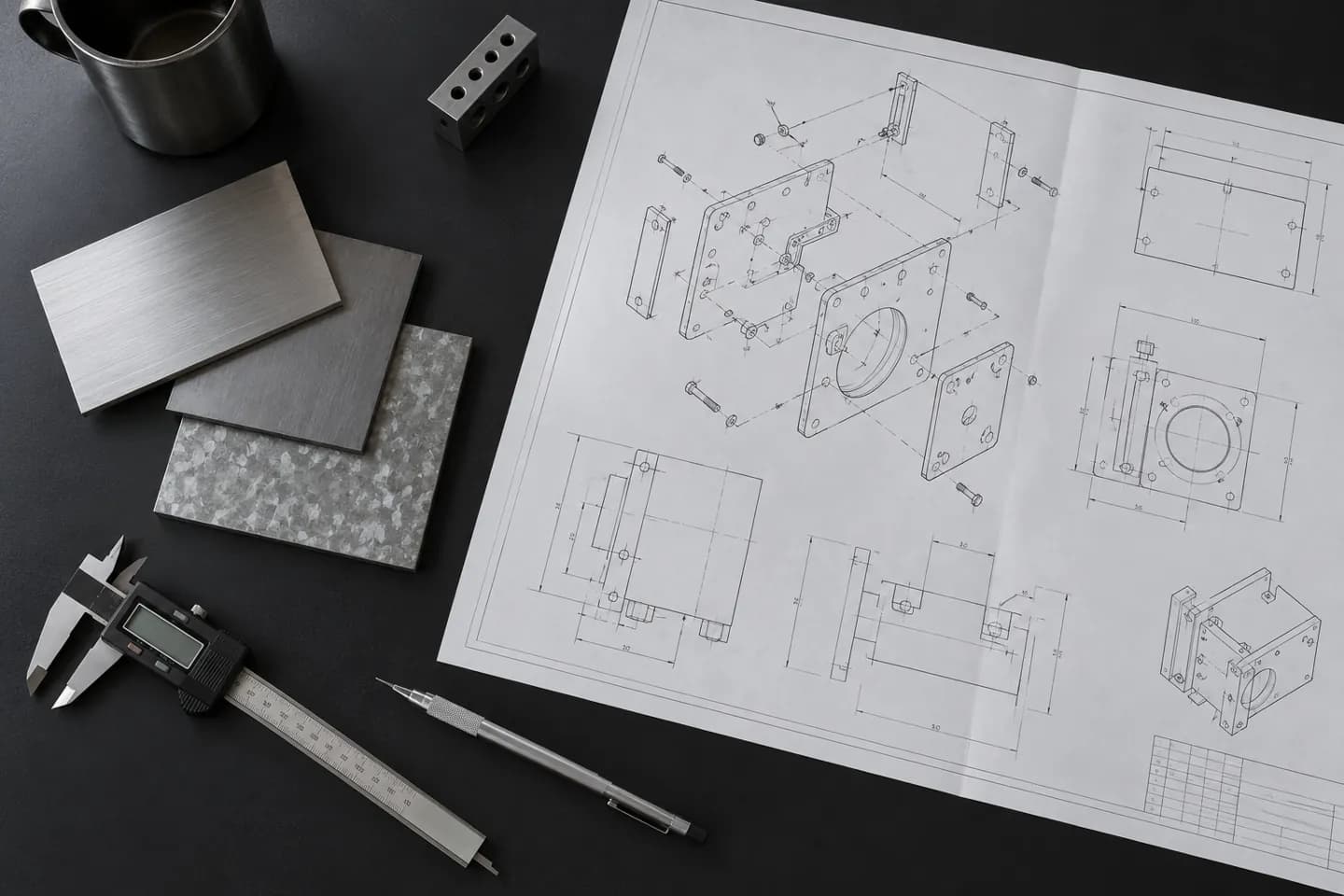
Give each part a number, revision and quantity. State whether dimensions are in millimetres or inches, and identify the controlling drawing when a PDF, CAD model and sketch differ. Mark reference dimensions and items awaiting site measurement. A readable dimensioned reference helps explain the intended finished geometry; a model alone may omit acceptance requirements. Do not add tool compensation without identifying it.
03
Separate material requirements from preferences
State the material family, grade or alloy, product form and thickness when known. For aluminum, include temper if specified. Identify corrosion exposure, temperature, cleaning products and compatibility with adjoining materials. If selection is undecided, describe those conditions and label the material as a preference. Any proposed substitution needs the purchaser or responsible designer’s approval before release.
04
Identify the interfaces that matter
Highlight holes, mating faces, bend relationships and connection points that control fit. Distinguish critical dimensions from general drawing tolerances and show the reference surfaces used for measurement. Provide assembly orientation, weld locations and hardware requirements. Avoid assigning one tight tolerance to every feature without a functional reason; feasibility and inspection effort need project review.
05
Define finish and acceptance together
Identify the required coating, surface treatment, appearance and surfaces that must remain uncoated. Describe colour or texture references and whether a sample needs approval. State which inspections, material records, welding documentation or test reports the project requires. Where a standard applies, give its exact designation, edition and required scope; a requirement in an RFQ is not proof that a supplier holds the relevant qualification.
06
Distinguish prototype from production
List prototype, initial batch and possible repeat quantities separately. Identify what must be checked before a production release, who can approve the sample, and whether the drawing may change after review. State packaging and part-identification needs. Repeat quantities are planning information, not an order commitment, and pricing assumptions should identify the batch they cover.
07
Make site and delivery responsibilities explicit
Provide the destination municipality and province, receiving hours, unloading resources and access restrictions. Identify whether field measurement, removal, installation, engineering or lifting is included or supplied by others. For occupied facilities, describe isolation, operating hours and coordination requirements. State the requested date and any fixed project milestones; delivery and installation availability remain subject to scope review.
08
Compare the same scope before authorizing work
Review the drawing revision, material, quantity, finish, inspections, exclusions and delivery basis in each quotation. Resolve unclear assumptions in writing and identify the person authorized to approve changes. Keep optional work separate from the base requirement. A submitted RFQ confirms an inquiry only; fabrication should follow an agreed scope and acceptance of the commercial terms.
Send only relevant project documents.
When secure uploads are available, the document step accepts PDF, DXF, DWG, STEP/STP, IGES/IGS and supported images, up to five files of 10 MB each. Uploaded files remain private and require security clearance before authorized access. Omit passwords, unrelated personal information and documents you are not authorized to share. You can submit a request without drawings.
Ready to define the work?
Start with what is known and identify the decisions that need review.